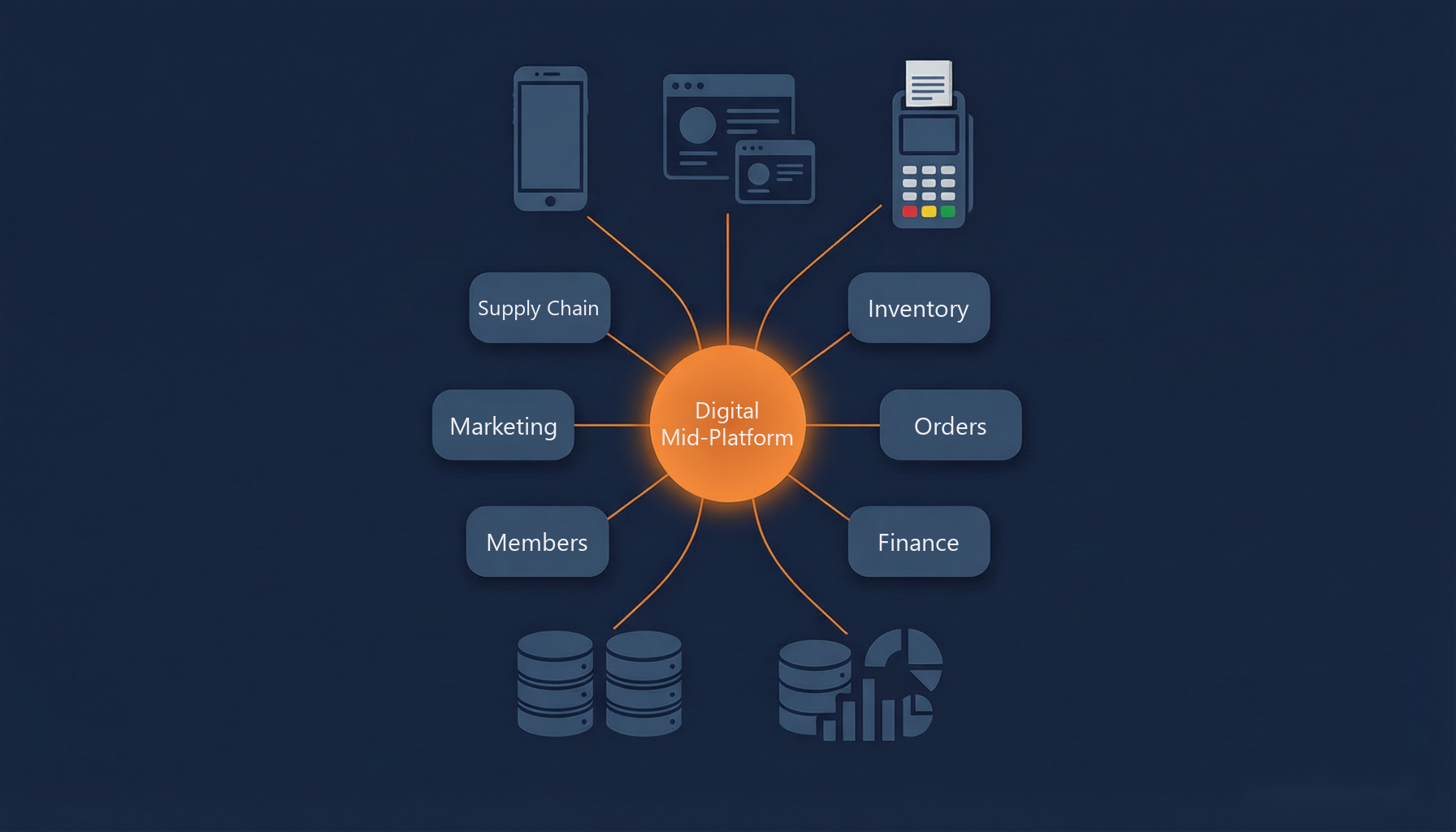
Store-centric, omni-channel business integration that delivers a complete digital closed loop — from procurement to sales and from online to offline.
Through a unified platform, centrally process orders, inventory, products, membership, and financial data across multiple platforms, channels, and touchpoints — including self-operated malls, offline stores, and third-party e-commerce platforms (Meituan, JD Daojia, Ele.me, Douyin) — achieving unified omni-channel operations.
Transforms the traditional sales model: customers order online and choose pickup at a nearby store, home delivery, or express shipping. Supports pre-order pickup, 1-hour delivery, community group buying, flash sales, and multiple other fulfillment options.
A full-process solution for chain retail delivery that resolves distribution challenges at low cost and high efficiency. Supports single-item sorting, store sorting, route sorting, and more — mobile smart sorting makes picking faster and more accurate.
A big-data-driven intelligent replenishment system supporting three models: OPL ordering, inventory upper/lower limits, and full-capacity ordering. Comprehensive reference data and a derivation-based procurement process improve operational accuracy and reduce inventory costs.
Electronic contracts, online reconciliation, electronic invoicing, and direct bank-enterprise connectivity save substantial paper and time costs every month. Leveraging Lakala's payment capabilities, it supports multi-level automated smart split settlement, avoids secondary settlement risks, and meets regulatory requirements.
One-click integration with all major payment channels including WeChat Pay, Alipay, and UnionPay QuickPass. Connects multiple platforms and payment channels via open APIs, switchable with one click in the backend, with automatic bill download and reconciliation.

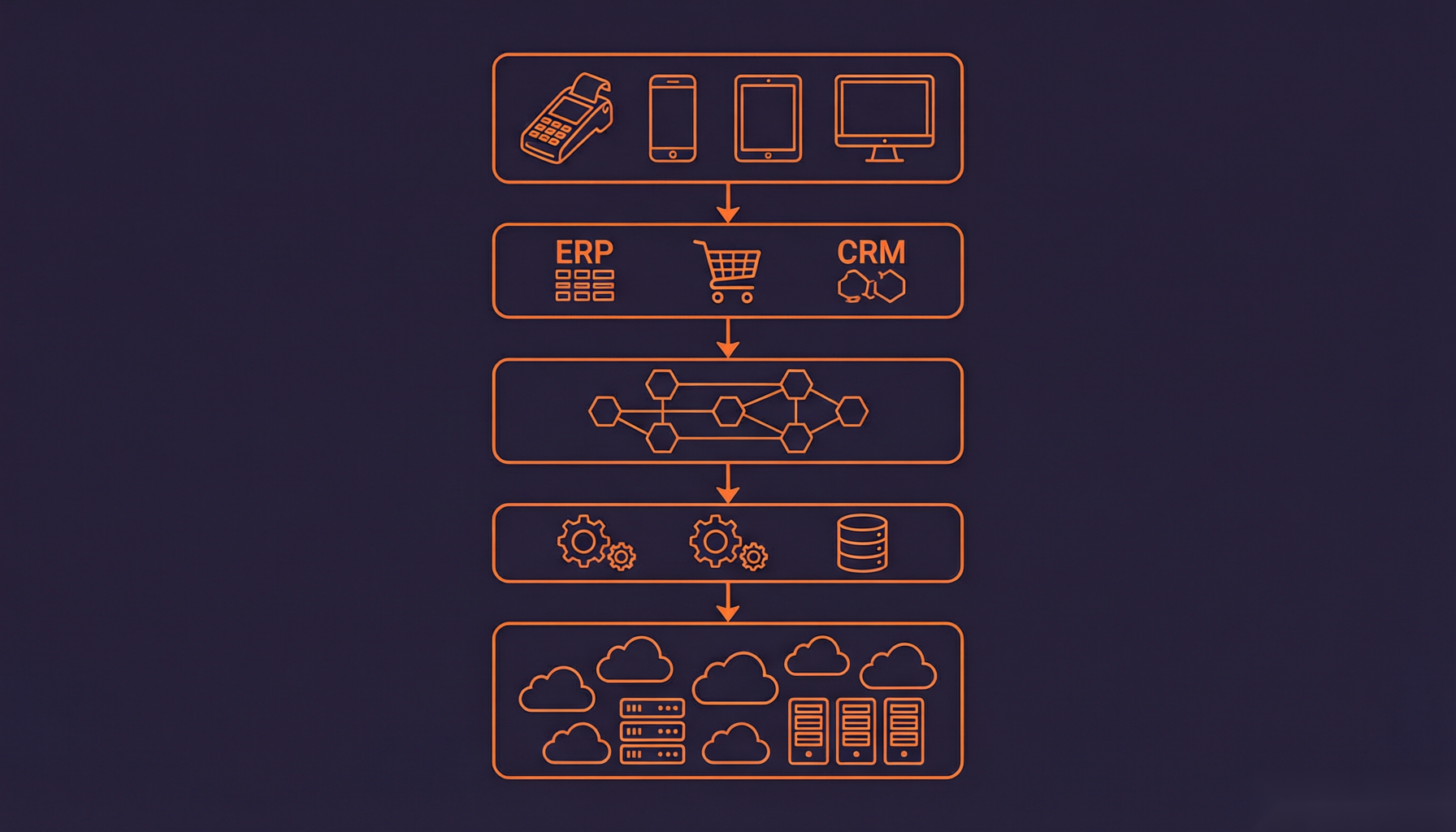
Full coverage across multiple platforms, business formats, and industries. A C/S + B/S + cloud hybrid model that supports professional operations across business formats and omni-channel management.
Six core modules — Product Center, Procurement Center, Marketing Center, Inventory Center, Finance Center, and Report Center — supporting multi-level, multi-format organizational structures with flexible permission control.
A lightweight management tool based on the WeChat Mini Program: view business data in real time and manage ordering, price adjustments, stocktaking, and product listing/delisting on the go — giving managers full control of their stores anytime, anywhere.
A cross-platform POS system available in keyboard, touchscreen, self-service, and mobile formats — integrating aggregated payments, member identification, offline selling, bilingual Chinese-English support, and AI-powered weighing.
An ECharts-based visual reporting system covering every dimension of sales, inventory, operations, and finance. Five abnormal-inventory alerts, plus BI reports that support enterprise secondary development.
A complete franchisee service management platform supporting franchise fee control, delivery control, and split settlement — powering rapid brand expansion with lightweight growth.
Fully open data dictionaries, an agile secondary development platform, and mature external interfaces. Supports PC, Mini Program, H5, App, and large-screen terminals, with separated front-end/back-end architecture for rapid delivery.
Built on internet microservices architecture and cloud services technology — distributed, high-concurrency, highly available, highly scalable, and multi-cloud adaptable.
The seven core centers of the Head Office Business Mid-Platform, plus the Store Operations System and the POS Checkout System, cover the entire chain retail business chain.
Full product lifecycle management with category management, product data import, and store-level product selection — enabling unified head-office control and personalized store operations.
Four levels — department, major, medium, minor — with support for up to five. Scientific category definitions referencing national standards, with SKU counts set per category per store to keep the category structure stable.
Supports common retail product information and ex-factory information, custom enterprise-specific business fields, batch product attribute setup, and store-specific custom attributes.
Multiple barcodes per product distinguish different origins and specifications; multiple suppliers per product with primary/secondary switching. Supports multi-unit management, BOM recipe management, and multiple specifications (model/color/size).
Dual dimensions of product grouping and classification, with branch-specific attributes and prices. Batch import templates improve the efficiency of entering master data.
Full supplier lifecycle management with contract-driven, fine-grained procurement — supporting the entire smart ordering and unified procurement & distribution process.
Supplier onboarding, profile maintenance, certificate management, and order-cycle control. Supports multiple supplier categories — self-operated, counter joint-operation, and leasing — with contracts spanning the full lifecycle.
Multiple operating modes (purchase-sales, joint operation, consignment, agency operation, counters, leasing), with contract-driven product management, expense management (fixed/temporary/dynamic), and supply relationship management.
Three models: OPL ordering (for products with stable daily sales), inventory upper/lower limits (for small-format stores), and full-capacity ordering. Smart suggestions plus stockout reminders improve operational accuracy.
A full-process chain retail delivery solution supporting ordering via PC web or WeChat Mini Program QR code scanning. Consolidated procurement lowers costs; inventory management becomes effortless.
Rich promotion types covering every known marketing approach, flexible strategy rules, multi-channel customer reach, and visual tracking across all marketing activity.
Bundled discounts, threshold discounts, gifts and add-on purchases at threshold, buy-N-get-one, multi-item multi-discounts, group buying, flash sales, purchase limits, limited-time discounts, coupons, and more — covering every marketing scenario.
Distinguishes head-office-controlled prices from store-controlled prices through a price composition system. Automated, intelligent price adjustment processes give the head office full visibility into store pricing.
Filter by status — running, pending review, terminated — and customize a visual campaign calendar overview. Flexibly combine promotion channels, targets, scope, and type.
Campaigns are trackable by year/month/day, region, and theme, with conditional grouping, peer comparison, and full-year statistics. Metrics are calculated automatically by formula, with real-time oversight.
Fine-grained inventory management combining batch costing and moving-average costing, with online-offline inventory sharing and 360° efficient control.
Batch inventory management supporting first-in-first-out, lowest-price-first, and other deduction rules. Online-offline inventory sharing, virtual inventory sales online, and configurable permission for negative-stock sales.
Product transfers between storage positions, stores, and logistics centers. Store transfers use a "virtual in / virtual out" mode to handle price differences among franchise stores.
Supports document-based, Mini Program, and mobile POS stocktaking. Count by category or by shelf, manage stocktake batches, and handle discrepancies with one click.
Inventory adjustments (shrinkage/surplus), shelf location management, inventory requisition (warehouse/store), recipe-based processing management (BOM), and cost anomaly correction.
Aggregates omni-channel orders with unified routing and fulfillment, blending online and offline orders and supporting multiple delivery methods.
Orders from self-built platforms, B2C malls, B2B malls, and public-domain platforms such as Meituan, JD Daojia, and Ele.me are received uniformly, with status feedback and data standardization.
Exception order handling, order merging/grouping/dispatching, and order automation. Supports single-warehouse and multi-warehouse picking allocation per product, with proximity-based smart routing.
Three fulfillment methods: express delivery, instant delivery, and store pickup. Online orders monitored in real time, standardized picking workflows, and automatic returns/stockout handling.
Real-time data interfaces (membership/stored-value cards), asynchronous interface services (suppliers/products/promotions/inbound), and scheduled push of store replenishment requests, sales orders, and inventory to third-party platforms.
An efficient, compliant digital solution for financial settlement — supporting online supplier reconciliation, multiple settlement modes, smart split settlement, and business-finance integration.
Suppliers confirm reconciliation of purchase and return documents on the supply chain platform. Supports multiple payment-term modes; the system automatically selects bills for settlement based on payment terms, with invoices entered and returned online.
Bill-based settlement for purchase-sales, settlement referencing sales for consignment, settlement referencing guaranteed minimums for joint operations, and pure-rent settlement for leased counters — covering every operating mode.
Leveraging Lakala's payment capabilities, supports ratio/amount-based split and real-time/delayed/balance/post settlement. Rules can be set per order, supplier, or product, avoiding secondary settlement risks.
Automatically generates accounting vouchers in a standard voucher format on schedule. A rigorous implementation methodology: requirements research → solution export → data initialization → training & testing → go-live.
Custom-developed, visualization-based data decision analytics covering every dimension of sales, inventory, operations, and finance, with five abnormal-inventory alerts.
Built on Baidu ECharts, the open-source visualization library. Charts and tables are fully configurable, and enterprises can do secondary development without compilation or release — flexible and convenient.
High inventory, slow-moving products, out-of-stock bestsellers, received-but-unsold items, seasonal/to-be-deleted products, negative inventory, and should-be-sold-but-not-ordered items — comprehensive monitoring of inventory health.
Basic reports (purchasing/receipts/single-item/inventory), business analytics (daily sales reports/abnormal inventory/time-slot/customer traffic), and operations analytics (supplier contribution/category comprehensive/turnover).
Core metrics such as sales per square meter, turnover rate, sell-through rate, contribution, cross ratio, days of supply, and new-product introduction rate — with multi-dimensional analysis by year/quarter/month/week/day/time slot.
A lightweight enterprise management tool built on the WeChat Mini Program — letting managers grasp business data anytime, anywhere, and letting operators work on the go.
Presidents, directors, supervisors, store staff, and franchise owners can view store performance reports in real time, anytime, anywhere — business data at a glance.
Product listing/delisting, ordering, price adjustment, inventory inquiry, and stocktaking. B2C-style product browsing is simple and intuitive, with barcode scanning for fast operation.
Fine-grained management for fresh food in single stores or chains — via single item, primary/secondary codes, or processing recipe lists. Precise loss control across requesting, procurement, delivery, and sales.
AI image recognition empowers traditional scales so customers and staff can weigh accurately — reducing mis-weighing losses and improving the customer experience.
One-stop ownership that meets every store need. A single system supports retail, food service, apparel, maternity & baby, and lifestyle services — with staffed, self-service, and mobile POS checkout.
Keyboard POS (custom shortcuts), touchscreen POS (custom layout/color scheme/multi-screen), PC all-in-one weighing scale, self-service POS, and mobile handheld POS — fitting every scenario.
Mixed payments with cash, WeChat Pay, Alipay, UnionPay QuickPass, BestPay, UnionPay, cards, and coupons. Connects multiple platforms and payment channels, switchable with one click in the backend, with automatic bill reconciliation.
Customers complete the entire flow themselves — member sign-in, product scanning, payment selection, and payment confirmation — boosting shopping efficiency and service experience while easing queues.
Supports offline sales with automatic sync once reconnected, sales data recovery, receipt reprinting, POS terminal lock/unlock, strict permission management, and automatic switching between Chinese and English.